How we evaluated this
This is a research-based review, not a hands-on test. Our sources are TopDon’s published specification sheet and product listing data captured on 24 October 2026, the subscription terms as published, owner feedback on the listing used as a lead-finding source (summarised in our own words and cross-checked against the specifications), and market context from competing tool lines. We did not use a unit, so we make no claims about scan speed, screen quality under shop lighting, or long-term reliability — the things only a bench test can settle. Where a manufacturer claim could not be verified against a second source, we flag it instead of repeating it. See our methodology for how scores are derived.
What the TOPDON ONE is
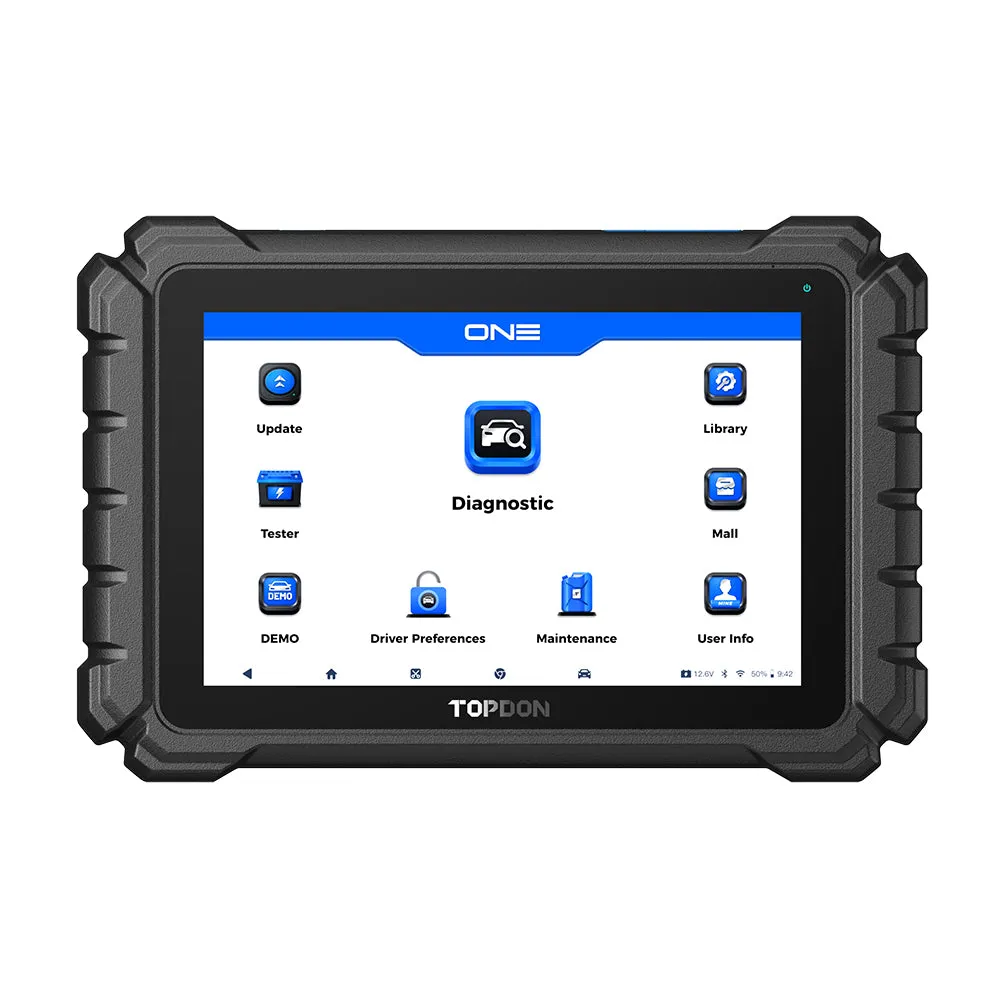
A 10.1-inch Android 12 tablet paired with a separate ONE VCI dongle. The tablet runs full-system diagnostics, bidirectional control, ECU coding, service resets and TopDon’s TopFix AI fault-code assistant; the dongle handles the vehicle link and doubles as a J2534 pass-thru device. Dual Wi-Fi replaces Bluetooth for the tablet-to-VCI link, which TopDon says is about three times faster.
The box includes the tablet, the VCI, a power adapter, an OBD-II extension cable, two USB-C cables and a quick guide. The extension cable matters more than it sounds: it lets the dongle hang clear of the footwell instead of being left behind in a customer’s car.
Capability breakdown
J2534 pass-thru
The included VCI supports the J2534 standard, so the tablet can act as a gateway between a laptop and the vehicle network for module programming and replacement. This is the single most consequential feature at this price: a standalone J2534 interface is its own purchase, and shops that skip it end up sending programming work out.
What the listing does not spell out is that J2534 is the pipe, not the content. You still need the manufacturer’s software subscription or token, and TopDon routes the workflow through its RLink platform. Budget for both.
Topology mapping and network diagnostics
Topology view renders the vehicle’s module network as a map, showing which ECUs are communicating and which are dark. For intermittent communication faults this shortens the diagnostic path considerably compared with paging through individual module menus. Combined with CAN-FD and DoIP support, it targets the 2013-and-newer vehicles where network faults are most common.
ECU coding and coverage
TopDon lists full ECU coding and hidden-feature support for ten of the most-serviced brands in North America, naming BMW, Volkswagen, Audi, Mercedes-Benz, Porsche, Toyota and Nissan among them, with automatic backup and restore before coding changes. VAG guided functions add step-by-step procedures, disassembly guidance and torque specs for Volkswagen and Audi work.
Service functions
More than 50 functions, with ADAS calibration, DPF regeneration, TPMS reset, ABS bleed and throttle adaptation called out specifically. TopDon notes that vehicle-specific availability varies — which is the honest caveat, and the one to check against your own job mix.
Protocols and model-year coverage
The published coverage table starts at 2013-and-newer BMW, 2016-and-newer Volkswagen and Volvo, 2017-and-newer Jaguar, 2018-and-newer Mercedes-Benz, and 2020-and-newer GM and Chrysler for advanced-protocol systems. Older vehicles remain diagnosable over standard protocols, but the headline capabilities are aimed at modern networks.
What the subscription actually costs you
This is the part of the listing that deserves a calculator, and the part most reviews skip.
One year of software updates is included in the $839. TopDon is currently adding a second year for units activated between 20 October and 20 December 2026, which the listing values at $299. After that, renewal is $299 a year.
In monthly terms that is about $24.90, or $0.82 a day. Against the purchase price, each renewal is roughly 36% of what the hardware cost.
Three years of coverage with the promotion comes to about $1,138; five years about $1,736.
Across five years the software line slightly exceeds the hardware price: 52% of total spend is subscription, not the tool.
Three ways to own it
| Approach | 5-year spend | What you get | What you give up |
|---|---|---|---|
| Renew every year | $1,736 | Continuous coverage, warranty stays active | Nothing material |
| Renew every other year | $1,437 | Coverage in alternate years | New model years during the gaps, warranty continuity |
| Never renew | $839 | The tool as shipped in 2026 | Model years released after coverage ends, warranty coverage |
Renew every year
$1,736
- What you get
- Continuous coverage, warranty stays active
- What you give up
- Nothing material
Renew every other year
$1,437
- What you get
- Coverage in alternate years
- What you give up
- New model years during the gaps, warranty continuity
Never renew
$839
- What you get
- The tool as shipped in 2026
- What you give up
- Model years released after coverage ends, warranty coverage
Figures assume the 2026 bonus year is claimed; without it, add $299 to each row.
What actually stops when it lapses
TopDon’s wording is more specific than “you lose updates”, and the three parts matter differently:
- Core diagnostics and bidirectional control keep working. The tool does not brick.
- New vehicle data stops. Model years released after your coverage ends are not added to the database.
- Hardware warranty coverage stops. This is the unusual part: the warranty is tied to an active subscription, where most tool makers warrant the hardware independently of the software plan.
For a shop working on late-model cars, the second point is a functional limit rather than a cosmetic one. The 2027 model that rolls in next year is exactly the kind of vehicle a subscription exists to cover.
The $119.99 alternative to keeping the subscription alive
There is a cheaper way to cover the hardware, and it sits on the same purchase page. Amazon sells a four-year protection plan for $119.99 — about 14% of the tablet’s price. Four years of renewals, counting the 2026 bonus year, come to $598. If the worry is the tablet failing rather than the vehicle database going stale, the plan answers that worry for a fifth of the money.
The two are not interchangeable. A protection plan is an insurance product with its own terms about what counts as a failure and how a claim is handled; the manufacturer warranty is a statement about defects, and TopDon ties it to the subscription. Read the plan’s terms before treating it as a replacement for either.
Amazon also offers Complete Protect, billed at $16.99 a month. It is a store-wide subscription rather than cover for this tool specifically, and at $204 a year it costs about a quarter of the tablet’s price annually. It arrives as an opt-in at checkout, so decline it unless you are buying electronics at volume.
There is a free 30-day refund or replacement window on the purchase page, which is the lowest-cost way to find out whether the coverage list matches your vehicles.
The daily-cost arithmetic does not add up
The listing frames the subscription as “$0.65/day.” At $299 a year the real figure is about $0.82 a day; $0.65 a day works out to roughly $237 a year. The comparison to a repair-manual subscription is fair in spirit — the arithmetic is not.
Three things to check before you buy
- Your model years are on the coverage list. The listing’s protocol table starts at 2013+ BMW, 2016+ Volkswagen and Volvo, 2018+ Mercedes-Benz, and 2020+ GM and Chrysler for advanced-protocol systems.
- What the warranty status is if you skip a year. Ask before you buy, not after.
- OEM programming costs sit outside this number. J2534 is the pipe; manufacturer software and tokens are separate purchases.
Where the marketing outruns the datasheet
Two claims in the listing are worth reading twice.
“Universal fit.” That label refers to the OBD-II connector, which fits everything with a 16-pin port. Function coverage is a different question entirely, and the listing’s own protocol table shows model-year floors by brand. Check your vehicles against the current coverage list.
“Dealer-level.” The hardware is genuinely dealer-adjacent — topology mapping and coding routines that mirror factory tools. But dealer-level capability in practice requires the manufacturer’s software subscription or token on top of the tablet. The ONE is the interface, not the licence.
One more spec worth noting: Android 12 on a device launched in 2026. It is a stable, well-supported release, but it is also two major versions behind current Android, and diagnostic tablets tend to be kept for five years or more.
What owner feedback adds
The listing carries 313 ratings averaging 4.5. We read the reviews shown there to work out what actually matters to owners — we do not reproduce them — and four themes come up again and again:
Topology view is the feature owners single out. It appears in almost every detailed account, usually in the context of spotting a module that has stopped communicating rather than paging through individual module menus. If you take one thing from owner experience, it is that this is the capability people end up using daily.
Connection stability gets mentioned second, with dual Wi-Fi cited as the practical difference from Bluetooth-based tools — faster handshake, less waiting between vehicles.
The service-function menu is what makes the tool earn its keep in small shops, particularly for resets and relearns that would otherwise mean buying a second device or turning the job away.
Update cadence is high and owners treat it as a positive, with fixes sometimes arriving within days of a reported bug.
The critical reviews are useful for a different reason: they cluster around software polish (UI text errors, a browser component that can fail), coverage gaps on specific brands, and VIN decoding on older vehicles. Those are the three things to test in your first week, which is exactly what the return window is for.
One caveat about the rating itself. Several of the critical reviews displayed on the listing are dated before this model’s 2026 launch, and one is titled for a different TopDon device entirely. That suggests the 4.5 average blends reviews across listing variants rather than measuring this tablet alone — treat the number as a rough signal, not a verdict.
How it compares
The obvious alternatives are Autel and Launch, both of which sell full-system tablets with bidirectional control, coding and service functions in overlapping price bands. TopDon’s differentiator at $839 is packaging: the J2534 VCI and topology mapping come in the base kit rather than as add-ons or higher-tier features. Autel and Launch generally have deeper coverage in specialist areas and larger independent user communities, which matters when you hit an unusual vehicle at 4pm on a Friday. Lower-cost options with J2534 and topology mapping have also appeared from brands such as Thinkcar, usually with fewer service functions and a shorter included-update period.
The practical comparison is not “which tablet has more features” but “which coverage list matches the cars in your bay.” That is a question no specification sheet answers for you. For the rest of the range, our TopDon brand page collects every model we have covered so far.
Who should buy it
Small shops, mobile technicians and advanced DIY owners working mainly on 2013-and-newer vehicles who want dealer-adjacent capability without a four-figure hardware bill. It is a poor fit if you specialise in one brand deeply enough to justify the OEM software subscription on its own, or if you will not maintain the annual renewal — in that case a cheaper tool with a lifetime-coverage model will serve you better.
If you want to see how it stacks up against the rest of the category, our automotive diagnostic tool comparison tracks the field.