How we evaluated this
Nothing in this review comes from a styling session we ran ourselves. We worked from wavytalk’s product listing and instruction text, the published specification set for model B390, current retail pricing across US retailers, and the themes that recur in the owner reviews shown on the listing. Manufacturer figures are labelled as such. Where our arithmetic and the listing disagree, we show the working rather than picking a side.
What the Steamline Pro is
Model B390 is a corded heated brush: a toothed comb head with a steam feed behind it, four heat steps, and a body that stays cool enough to bring close to the scalp. The pitch is that you brush sections straight in one pass while steam keeps the cuticle from drying out, instead of clamping hair between two hot plates.
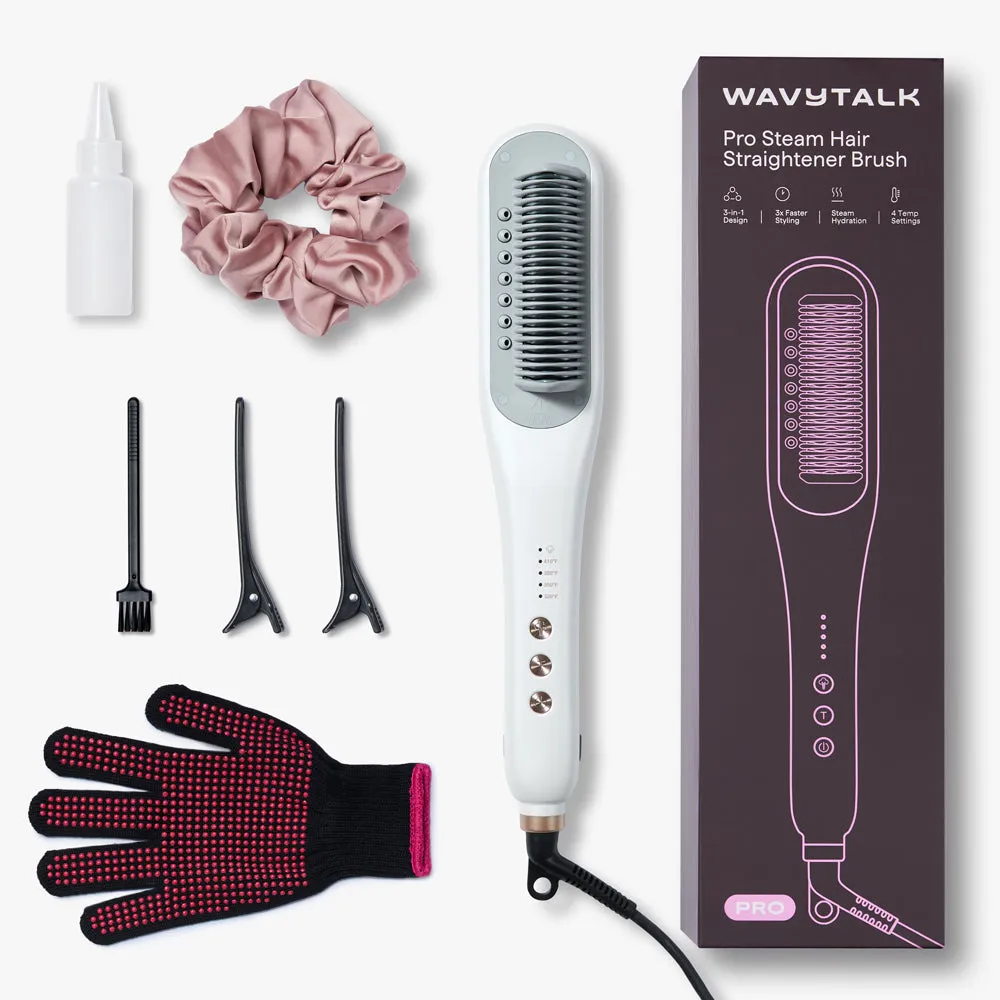
The box is more complete than the listing’s structured data suggests — that field lists only “hair clip” under included components, but what ships is the brush, a heat-resistant glove, two sectioning clips, a small cleaning brush, a dropper bottle for water, and a scrunchie. Nothing extra to buy on day one.
The steam claim, checked against the tank
wavytalk rates steam output at 0.5 ml per minute. Run that for thirty minutes and you have used about 15 ml of water, so a reservoir that genuinely covers the claimed session has to hold roughly that much.
Owner feedback points to real sessions running longer than the claim assumes. People with very thick or type 4 hair describe refilling two to four times to finish a head, and one times the session at 45 minutes. That is not a fault so much as arithmetic: more hair means more passes, more passes means more minutes, and the tank is sized for the shorter session.
Distilled water is not a suggestion. The manual asks for it specifically to stop mineral build-up blocking the nozzles — and a blocked nozzle is the usual way a steam brush stops steaming.
The four percentages
The listing leads with 101% shinier, 77% smoother, 62% less frizz and 27% more resistance to breakage, all against “traditional flat irons”. None of the four comes with a test protocol, a sample size, an instrument or a time frame. Shine is a reflectance measurement, and a figure above 100% implies the measured value doubled — a strong claim to publish without the method.
That does not make the claims false. Owners consistently describe less of the scorched-hair smell and less dryness than they got from daily plate ironing, which is the effect the mechanism predicts. It means the numbers are marketing rather than measurement, and the thing worth weighing is the mechanism — moisture before heat — not the percentages.
The temperature ladder contradicts the spec line
The listing’s feature text says four settings spanning 325°F to 410°F. The device’s own printed ladder, legible in wavytalk’s product photography, reads 410 / 380 / 350 / 320 — so the bottom step is 320°F, not 325°F. A small discrepancy, but it changes the answer for one group of users.
The safety section of the same listing advises keeping the tool at no more than 320°F for fine, thin or fragile hair. That is exactly the lowest setting, which leaves fine-haired users one usable step and no headroom underneath it: if 320°F still feels hot on your hair, there is nothing lower to select.
Read that as a design statement rather than a defect. The tool is built for medium to coarse textures, and fine hair is being accommodated in the manual rather than in the hardware. If your hair is fine or fragile, the honest conclusion is that this is the wrong tool, not a tool to use carefully.
What it is genuinely good at
Roots and edges. The teeth are guarded and the housing runs cooler than a plate, so you can work close to the scalp without flinching. Several owners mention this, and it is the one thing the design does that a flat iron structurally cannot.
Speed on coarse hair. Multiple owners report styling time dropping from around 25 minutes to under 10, or from four hours to under two. Those are owner reports, not our measurements, but the direction is consistent across textures and hair types.
Nothing to re-buy. No cartridges, no proprietary refill, no app — the only thing you keep buying is distilled water, measured in millilitres per session.
What you get if it dies. The product listing does not state a manufacturer warranty period, but the purchase page carries three separate safety nets, and they are worth pricing before you write the tool off as a gamble:
- a free 30-day refund or replacement window;
- a protection plan priced once, not monthly: $6.99 for two years, $8.99 for three — about 8% and 10% of the purchase price;
- Complete Protect, which is billed monthly at $16.99 and is an Amazon-wide plan rather than a product warranty.
Those time bases are easy to mix up, so keep them apart. The two protection plans are one-off payments covering the whole term. Complete Protect is a subscription: $16.99 a month works out to about $204 a year, on a device that lists at $99.97. It is opt-in and easy to accept at checkout without registering the cadence. Take the $8.99 three-year plan if you want cover; decline the monthly bundle unless you are buying enough electronics for it to make sense.
The price moves, so the arithmetic has two rows. At the $63.82 deal price, three years of covered use costs $72.81 — about $24 a year. At the $99.97 list price it costs $108.96, or about $36 a year. The plan price does not move; only the device price does, which is why the comparison is anchored on the plan and shown both ways.
Where it falls short
Ends. A brush cannot clamp and pull the way a plate can, so the last few centimetres usually need an extra pass or a second tool. It comes up repeatedly in the reviews we read.
Silk press. Straight is not the same as pressed. People with type 4 hair describe a smooth, manageable result rather than the mirror finish of a salon press.
Shape. It straightens. It does not curl, wave or flick. If you want one tool for several styles, this is the wrong geometry.
Weight and cord. Around 1.15 lb with a cord attached and no cordless version, so it is a bathroom-counter tool rather than a travel-afterthought — dual voltage helps abroad, but you still need a plug adapter for the US polarized plug.
How it compares
Against a flat iron: slower per section, safer near the scalp, usable on damp hair according to owners, weaker on ends. Against a hot air brush: less volume, more straightening.
Several owners frame the purchase as a substitute for regular salon straightening. We have not priced that comparison, and the tool does not produce a silk press, so treat it as a convenience trade rather than a calculated saving.
Who should buy it
Buy it if you have thick, curly, coily or 4C hair, you style it yourself, and the bottleneck is the twenty to forty minutes of sectioning rather than the final result. Buy it if you want to stop booking a blowout every two weeks.
Skip it if your hair is fine or fragile — the temperature floor sits above your ceiling. Skip it if you want silk-press results or a tool that also curls.